

Description
Buy Retatrutide Peptide
Retatrutide is an experimental peptide being studied in scientific studies as triple agonist of the GLP-1, GIP and glucagon receptors. Research focuses on mechanisms surrounding body weight, energy balance and metabolic regulation. FIT PEPTIDES Retatrutide is a research-grade product for professional laboratory research, such as in vitro studies, analytical testing and method development.
Scientific background
In the literature, Retatrutide is being studied for its simultaneous activation of three hormone receptors involved in glucose metabolism, appetite regulation, and energy expenditure. This combined receptor interaction provides researchers with a model for synergistic effects to analyze within metabolic signaling pathways.
Research focuses on factors such as the influence on energy balance, fat and glucose metabolism, and hormonal feedback mechanisms. The translation of these findings into practical applications outside of controlled studies is unsubstantiated.
Possible research areas and effects
Within controlled research designs, the following areas are being studied with Retatrutide, among others. This concerns research observations and no claims:
- Weight and energy balance – analysis of changes in energy intake and expenditure
in experimental models. - Metabolic regulation – research into glucose and fat metabolism and hormonal
feedback loops. - Receptor interactions – study of combined GLP-1, GIP and
glucagon receptor activation. - Endocrine signaling pathways – insight into how multiple hormone axes work simultaneously
are affected.
The observed effects are highly dependent on study design, model and context and say nothing about safety or suitability for use outside the laboratory.
Safety and research context
Retatrutide is not a regulated pharmaceutical product and is not intended for clinical or veterinary use. The product is intended for professional use only.
researchers and R&D environments.
- For research purposes only
(e.g. in vitro, reference standard, assay development) - Use in accordance with internal laboratory protocols
- Keep out of reach of unauthorized persons
Use outside controlled research settings carries increased and unpredictable risks, partly due to the lack of extensive long-term data.
Retatrutide has been recognised for its impressive potential in:
- Weight management
- Diabetes research
- Metabolic function
- Glucose control
Consequently, retatrutide represents a significant advancement at the forefront of peptide science.
Retatrutide is a novel triagonist peptide that simultaneously targets three critical metabolic receptors:
- Glucagon-like peptide-1 (GLP-1)
- Glucose-dependent insulinotropic polypeptide (GIP)
- Glucagon
Originally developed for clinical research into obesity and metabolic disorders, retatrutide is designed to support extensive scientific exploration of:
- Weight reduction
- Improved glucose management
- Enhanced metabolic function
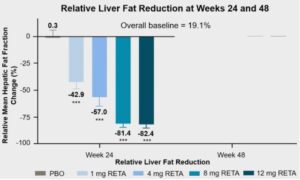
Retatrutide showed greater liver fat reduction and great improvements in NASH-related biomarkers (K-18 and Pro-C3).
At the doses of 8 mg and 12 mg, the average relative liver fat reduction rate of patients was >80%.
At the doses of 8 mg and 12 mg, more than 80% of patients achieved a fat loss rate of ≥70%.
At the doses of 8 mg and 12 mg, >85% of patients lost liver fat at 48 weeks.
At the highest dose of retatrutide (12 mg size), more than 90% of obese and NAFLD patients achieved great effect of liver fat. This suggests that the addition of GCG agonism to GlP and/or GlP-1 may have a beneficial effect on NAFLD / NASH patients. It have more powerful strong effects as far as we know.
The current pilot lab data, as well as the weight loss results from the main Phase 2 trial data, provide further evaluation of retatrutide in patients with
|
5mg
10mg
20mg
30mg
40mg
50mg
60mg
100mg
|




Reviews
There are no reviews yet.